
How to Read an Opportunity Card (Score, Confidence, Evidence)
Learn how to interpret Worth-it Score and confidence, verify evidence, and turn Opportunity Cards into build/hold/kill decisions
Signal Hunt generates Opportunity Cards so you can go from “interesting Reddit threads” to a decision you can defend.
This guide shows you how to:
- Read the score and confidence correctly
- Verify evidence fast (without trusting summaries blindly)
- Use missing signals as a clear next-step research plan
- Export/share the card as Markdown
What an Opportunity Card Represents
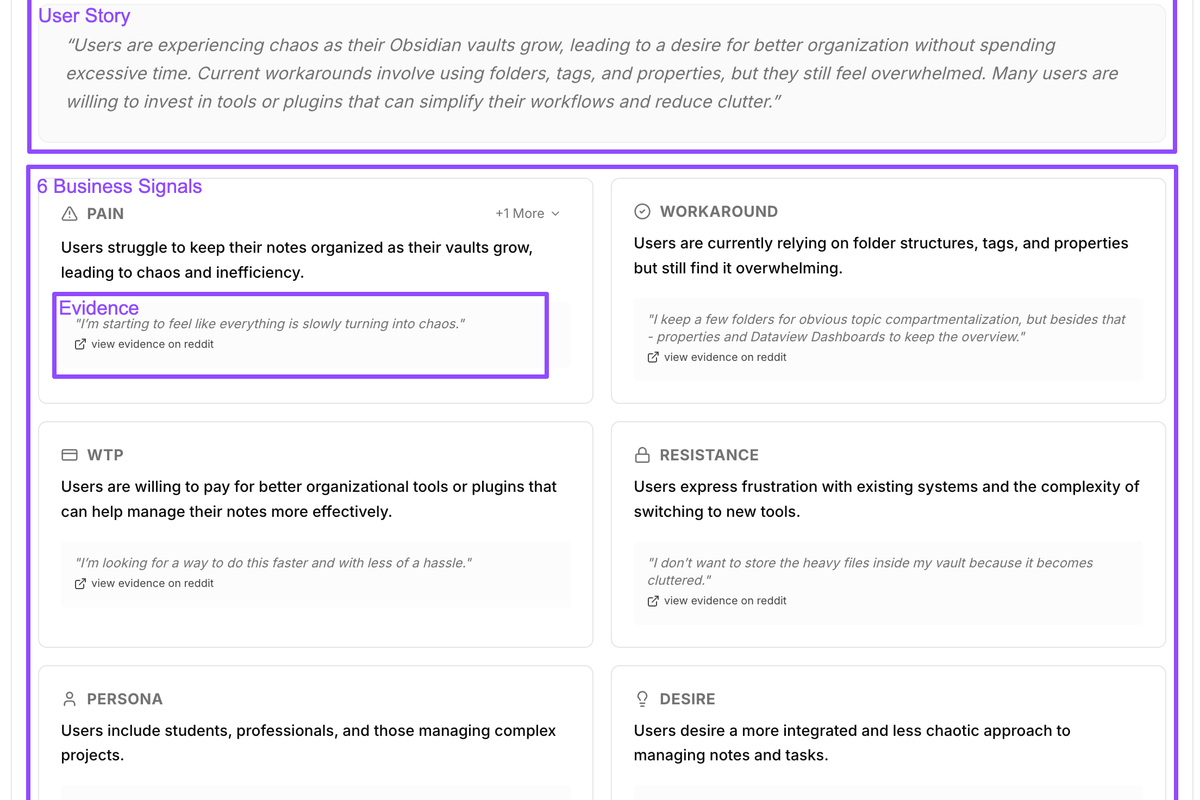
One card is one underlying Pain (a concrete struggle in a real workflow).
Everything else—Workaround, WTP, Resistance, Persona, Desire—should clearly refer to that same pain. If signals are missing, that’s normal. It just means the source data didn’t support them.
The Anatomy of a Card
1) Title
The title is a short label for the pain cluster. Treat it as a hook, not proof.
What to do:
- Use the title to decide what to click into first
- Validate the pain by reading evidence immediately (don’t “fall in love” with a good title)
2) Worth-it Score (How much evidence density)
Worth-it Score is a simple prioritization shortcut. In general, higher scores mean the opportunity has more signals supported by evidence (especially Workaround and WTP).
Signal Hunt’s scoring rule (conceptually):
- Pain is required (baseline)
- Workaround adds a big boost
- WTP adds a big boost
- Persona and Desire add smaller boosts
How to use it:
- Start from the top-scoring 1–3 opportunities
- Treat low scores as “interesting, but needs more evidence”
3) Confidence (How reliable the card is)
Confidence is a quality hint based on how clear Pain is and whether at least one strong validation signal exists.
How to use it:
- High: prioritize; likely has clear pain plus strong Workaround or WTP evidence
- Medium: good candidate, but you’ll want to verify and fill missing gaps
- Low: treat as weak/ambiguous until evidence proves otherwise
Confidence is never a substitute for reading evidence.
4) The 6 Signals (What you’re actually validating)
Use signals like a decision checklist:
- Pain: what breaks in the workflow, how often, and what it costs
- Workaround: what people do today to survive (manual steps, scripts, tool chains, hiring humans)
- WTP: pricing, budgets, spend, willingness/unwillingness to pay
- Resistance: switching friction (migration, lock-in, trust, compliance, learning curve)
- Persona: who is speaking and whether they’re a buyer/user/influencer
- Desire: the “ideal outcome” language (useful for positioning and messaging)
If a signal is empty/missing, treat it as a task: “collect evidence for this signal or move on.”
5) Evidence (The only thing you should trust)
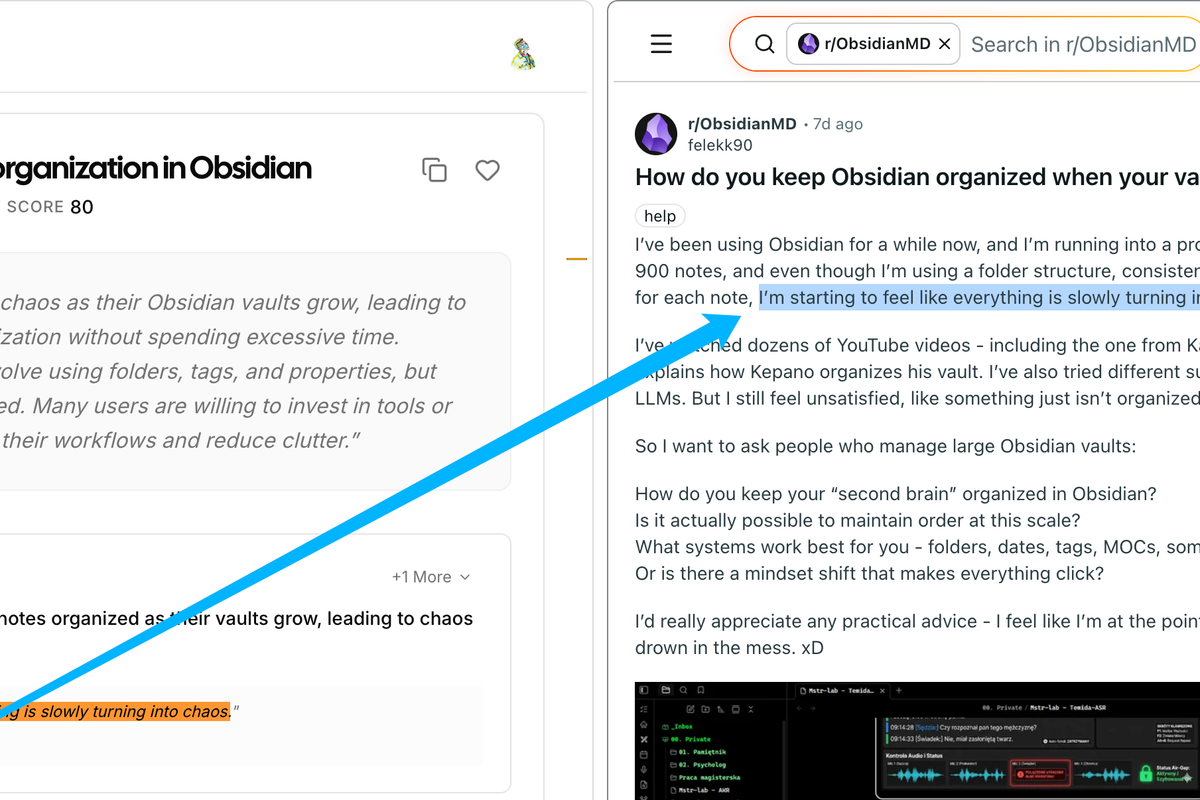
Evidence links are the heart of Signal Hunt. They let you click through and verify each claim.
When you open evidence, ask:
- Is this a real workflow pain, or generic complaining?
- Does the quote actually support this signal (Workaround vs Desire is a common mix-up)?
- Is the speaker in a context that makes the pain expensive?
- Are there counterpoints in the same thread that limit the segment (“not a problem”, “solved already”, “not worth paying”)?
Turn a Card Into a Decision (Greenlight / Hold / Kill)
Use this simple pattern:
Greenlight (go deeper)
Greenlight when:
- Pain is concrete and repeated
- Workaround and/or WTP evidence is strong
- Resistance feels manageable or points to a clear wedge
Your next step:
- Export the card as Markdown
- Reach out to commenters who show Workaround/WTP signals
Hold (collect missing signals)
Hold when:
- Pain is clear, but Workaround and WTP are missing or thin
Your next step:
- Run another scan targeting the missing signals (e.g. pricing threads, “how do you handle…” threads, tool comparison posts)
Kill (move on)
Kill when:
- Pain is vague after clicking evidence
- There are no real workarounds and no budget intent
- Counter-evidence dominates (“solved already”, “not worth paying”, “wouldn’t trust”)
Write down why you killed it. That “kill list” compounds over time.
Share and Save (Make Research Compound)
Signal Hunt is designed to make research reusable:
- Copy as Markdown to paste into Notion/Docs
- View in Dashboard to keep an evidence-backed record of what you found
Recommended Next Read
- Guide #1: The 6 Business Signals Pack (for deeper signal definitions)
- Guide: What to do when you get 0 opportunities (fast troubleshooting)